


 Folding boxes




 Shipping boxes



 Stand-up pouch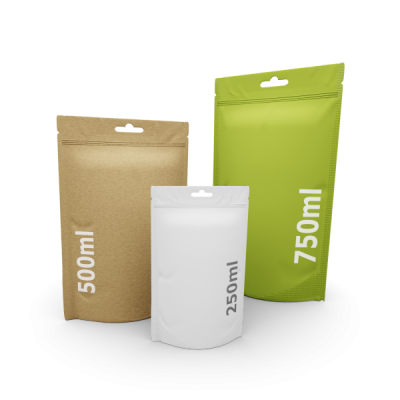


.png) Labels
Labels 

 Paper cans
  Sample boxes
 Bag production
Flexible packaging is often purchased in rolls and further processed on a corresponding VFFS or HFFS system. In most cases, the product is filled directly inline and the packaging is sealed. However, prefabricated bags such as sealed-edge bags or stand-up pouches are required for various applications. These are then opened, filled and sealed/welded either manually or by machine.
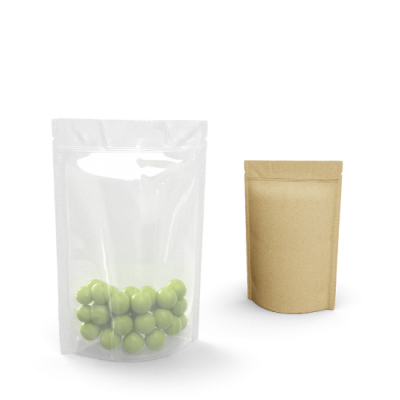
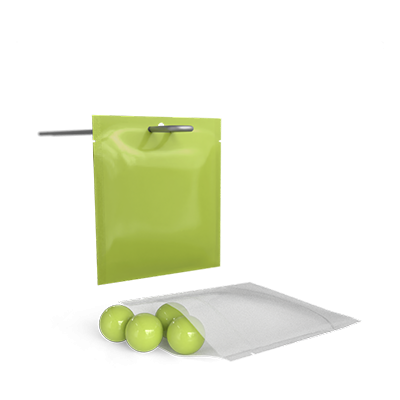
There are many types of pre-made bags, which differ mainly in their folding pattern and sealing geometry. Stand-up pouches are the most popular bag shape alongside gusseted bags and flat bags. Stand-up pouches have a base that can be stood upright – the side seams are simply welded together. Various zip closures can be integrated into the pouch so that the end consumer can reseal it.
Basic principle of bag production
In the manufacturing process for pre-made bags, the film web is first unwound from the roll and then formed into the desired bag type (e.g. flat bag, side gusseted bag or stand-up pouch) within the machine via a folding and forming process. If desired, a closed, resealable zipper can be inserted and sealed before the actual sealing process; This can then be reopened to facilitate the subsequent filling process. Particularly sensitive areas – e.g. the side zip area – can also be processed using ultrasonic welding before final sealing to achieve maximum tightness in these areas. The web is then heat-sealed at the designated points to create the bottom and side seams: The inner, sealable layer (e.g. PE or PP) is welded. To prevent the folded bottom or overlapping areas on the outside from being accidentally ‘welded’ during sealing, the outer layer is typically a non-sealable, thermostable printing film such as BOPP, PET or MDO-PE. Depending on the design, features can then be punched out (e.g. Euro holes, tear notches/tabs or carrying handles). At the end of the machine, the finished bag is separated from the web (e.g. by a knife or punching contour) and then collected in the delivery or packed directly.