

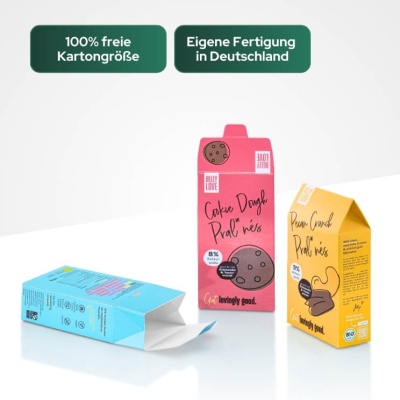
 Folding boxes
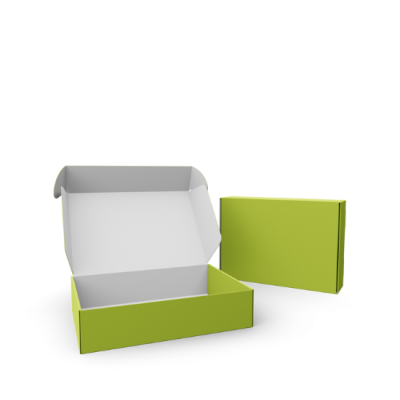




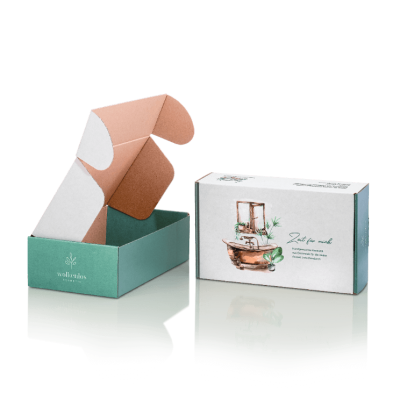 Shipping boxes





 Stand-up pouch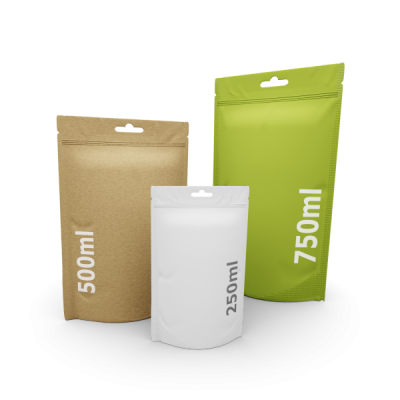


.png) Labels
Labels 

 Paper cans
  Sample boxes
 The abbreviation AlOx stands for aluminium oxide and describes an ultra-thin, high-barrier inorganic coating that is usually applied to PET and BOPP films using a vacuum process. AlOx barriers are applied to the carrier film with a thickness in the nanometre range and are transparent.
Characteristics
- Appearance: Transparent/clear
- Barrier: Very high oxygen (O₂) and water vapour (H₂O) barrier
- Layer thickness: Nanometre range
Note: Barrier performance comparable to aluminium, but affected by mechanical stress.
Application
AlOx is primarily used in transparent food films, for example to provide PP mono-materials with very high barrier performance. AlOx is applied to a carrier film such as BOPP and replaces traditional aluminium barriers in many applications.
Barrier performance
AlOX-coated films have very high oxygen and water vapour barriers, which can be impaired by mechanical stresses such as kinks. OTR and WVTR values of <= 0.5-1 are possible for AlOx barriers, which means they can be classified as ‘high barrier’ (depending on the overall composite and test conditions).
Recycling
Monomaterials (e.g. polypropylene composites) with an AlOx barrier can be recycled very well according to design-for-recycling assessments. AlOx barriers are often preferred to polymer barriers such as EVOH because they have far less impact on the quality of the recyclate (AlOx content in the packaging is often <1%).
Sources as of 23 January 2025:
- Frauenhofer-Institut für Verfahrenstechnik und Verpackung IVV;
- RecyClass;
- JindalFilms;
- CEFLEX