

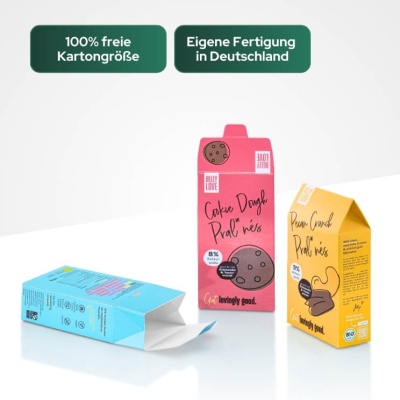
 Folding boxes
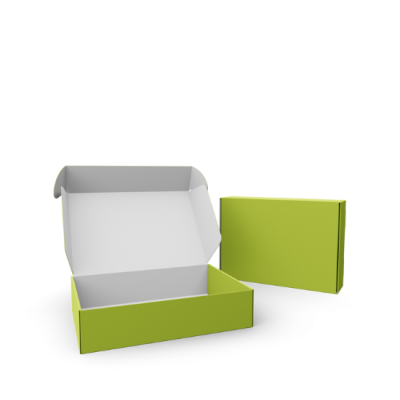




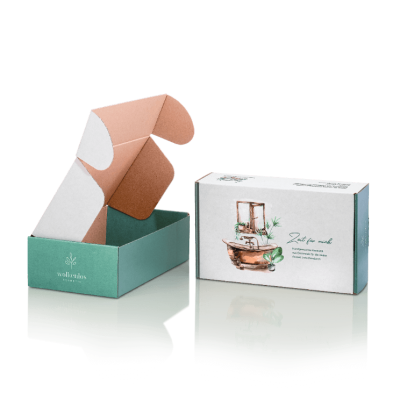 Shipping boxes





 Stand-up pouch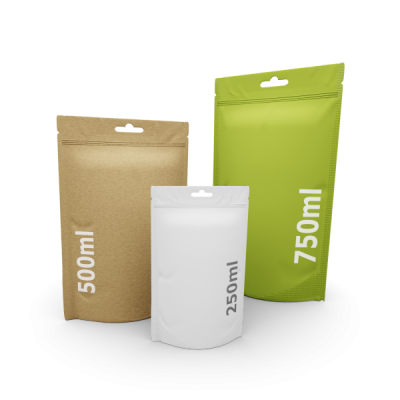


.png) Labels
Labels 

 Paper cans
  Sample boxes
 Metallisation refers to aluminium-metallised barriers that are applied to a carrier film (e.g. BOPP or PET) in nanometre-thin layers using vacuum coating (PVD). This process enables very high oxygen, water vapour and light barriers to be achieved with minimal material usage.
Properties
- Appearance: Opaque / silver / reflective
- Barrier: Very high oxygen (O₂) and water vapour (H₂O) barrier
- Layer thickness: Nanometre range
- Note: The good barrier properties can be impaired by mechanical stress and microdefects.
Application
Metallised barrier films are often used as a functional middle layer in composite or mono-materials (PETmet/PE, OPPmet/CPP) where, in addition to an oxygen and water vapour barrier, a light barrier is also required (e.g. for coffee, snacks and powdered products).
Barrier performance
Metallised films enable ultra-high barriers with ORT and WVTR values of <= 0.1. The barrier performance depends on the metallisation quality, layer thickness, overall composite and test conditions. During film processing, mechanical stress can reduce the barrier performance – this is caused by creases and material stretching.
Recycling
Metallised PP mono-materials (OPPmet/CPP) are recyclable because the layer thickness of the metallisation is in the nanometre range. In practice, metallisation can influence sorting if it is visible on the outside of the packaging due to reflections. If the metallisation is overprinted to provide coverage or is enclosed in the core of the material so that it is not visible, NIR systems can reliably identify the materials. Both composite and mono-materials with metallisation should be disposed of in the yellow bag in Germany.
Depending on the process, the quality of the recyclate can lead to optical clouding of the recyclate. Processing is still possible, but the purity and appearance may be limited. Recyclates from this are often used for applications with lower optical requirements (e.g. in non-food applications).
Sources as of 23 January 2025:
- ZSVR (Mindeststandard 2025);
- CEFLEX: NIR-Sortierung bei außen sichtbarer Metallisierung;
- Taghleef Industries