

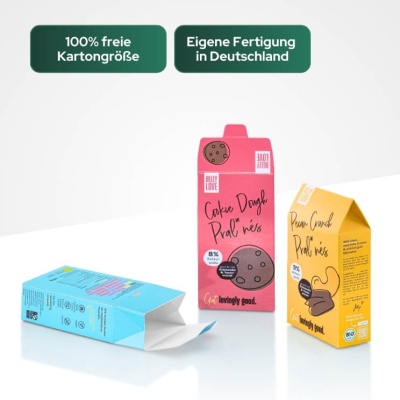
 Folding boxes
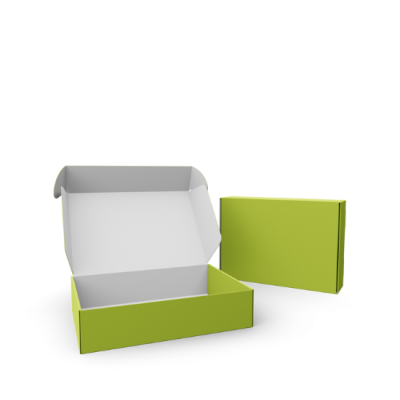




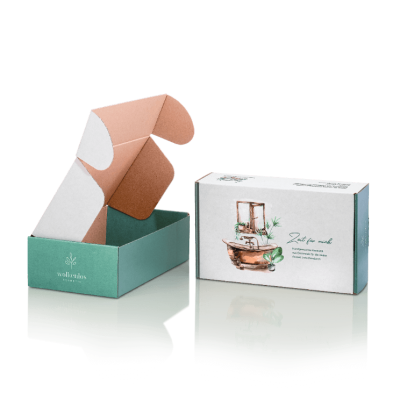 Shipping boxes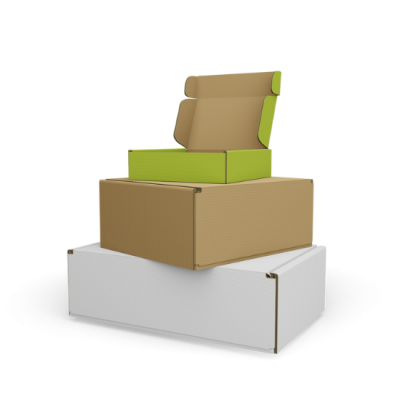



 Stand-up pouch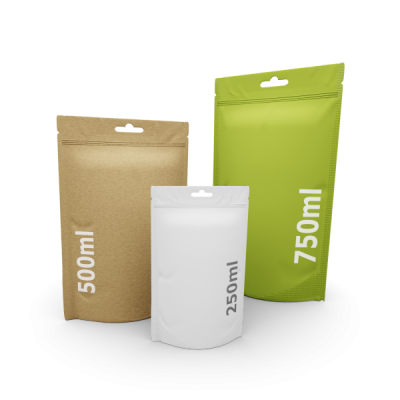


.png) Labels
Labels 

 Paper cans
  Sample boxes
 Polypropylene (PP) belongs to the polyolefin group and, thanks to its versatile properties, is suitable for many different FlexPack applications. Polypropylene serves as both a printing and sealing medium. In combination with barriers such as AlOx, EVOH or metallisation, BOPP films serve as functional components in multi-layer films.
Film types & applications
- Oriented PP films (OPP/BOPP) are often used as the printing and outer layer of packaging (18-25 µm). They have good processing properties, high stability and a good appearance. Non-sealable BOPP films serve as printing films and are used as surface films for complex packaging such as stand-up pouches or side gusset pouches. Single- or double-sided sealable BOPP films are used as printing and sealing media.
- Cast PP (Cast-PP) has excellent stability and sealing properties. It is used in various thicknesses (20–150 µm) as a sealing medium. CPP sealing films offer advantages over thin BOPP films, especially in contaminated sealing areas (e.g. due to powder residues from the filling process).
Properties
Polypropylene films are stiffer than PE films and offer different so-called SIT points (seal initiation temperatures) depending on the film type. Low-SIT films (BOPP & CPP) have sealing temperatures in the range of ~85–95 °C, depending on the design, while films for retort applications often require higher sealing temperatures of 155–175 °C (seal seams must remain stable even at 121–135 °C). Thermostable/non-sealable BOPP films are mainly used for applications where overlapping films must not be sealed together under any circumstances (e.g. the bottom of a Doypack or the side gussets of a side gusset bag). PP becomes brittle when cold and is therefore not suitable for deep-freeze applications.
Pure PP films are available in transparent and white versions and offer optimum machine running properties. Foamed BOPP films have special properties – they are lighter, offer improved opacity and provide increased thermal insulation.
PP offers a good water vapour barrier (WVTR). For high-barrier films, additional barriers such as EVOH, AlOx or metallisation are added in practice.
Recycling
In monomaterial structures, PP films can be recycled very well mechanically. The addition of printing inks, adhesives or barriers can influence mechanical recycling or reduce the recycling rate.
Sources as of 23 January 2025:
- Recyclass;
- CEFLEX;
- Plasticseurope